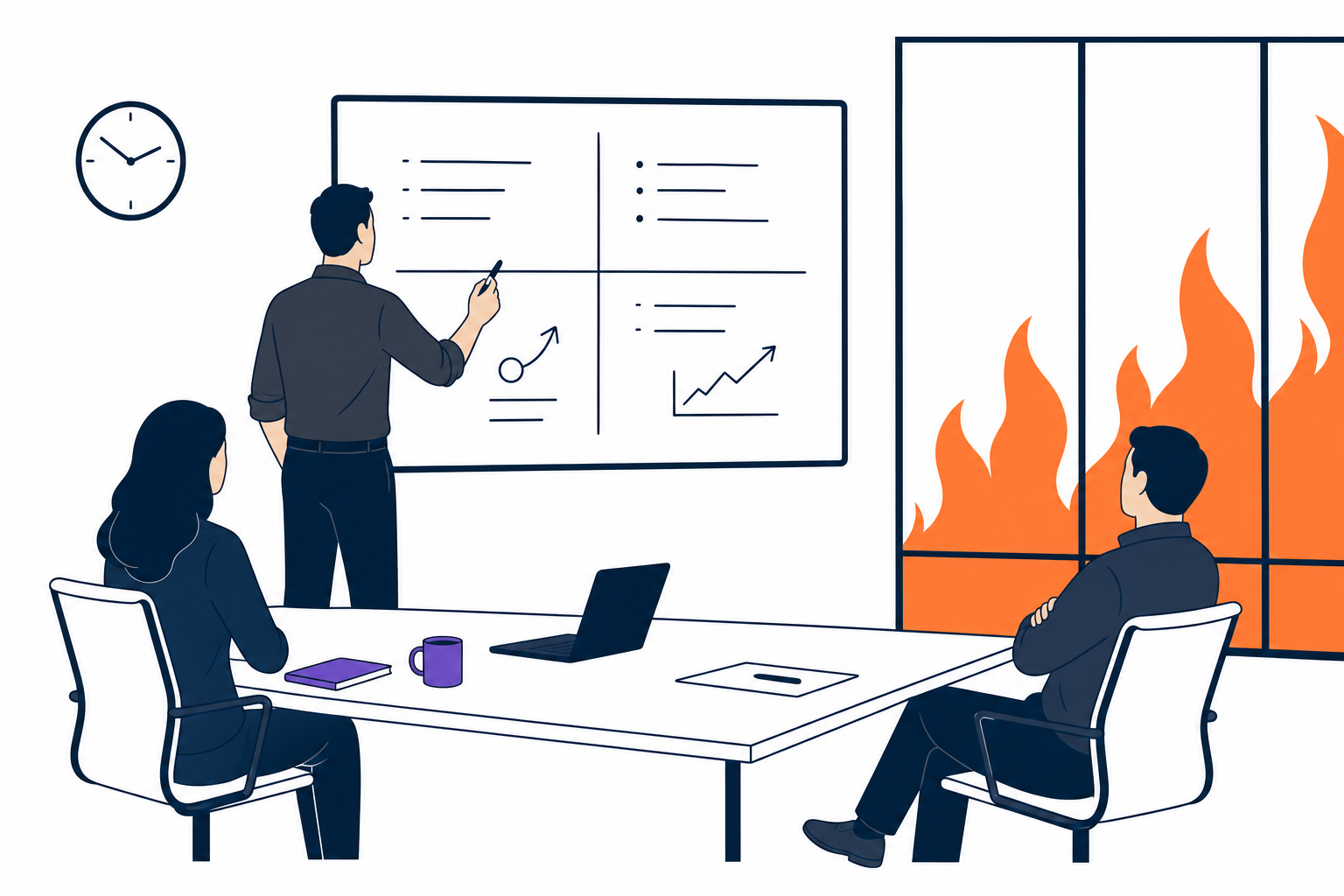
Customers don't evaluate you in isolation. They compare you to the last brand that handled a return gracefully, the competitor whose app didn't make them re-enter their address three times, the company that actually followed up. When you look at your own customer experience data without looking at your competitors' at the same moment, on the same signals, you're solving the wrong equation. The outside-in view fixes that: it holds every player in a category to identical evidence and identical standards, so you stop optimizing against your own historical average and start seeing what customers see, which is a field of options, not a single brand story.
Your Internal Data Is Flattering You
Every brand's own research has a thumb on the scale. Survey instruments, timing, and question framing all tilt toward confirming the investment already made. A brand that just redesigned its checkout flow asks customers about checkout satisfaction. A brand that leaned hard into loyalty asks about loyalty perception. The result is a body of data that tells you where you've been paying attention, not where customers are frustrated or fleeing.
The outside-in standard removes that thumb. When the same customer signals, review corpora, and behavioral patterns are analyzed across your brand and your three closest competitors at the same time, the gaps that were invisible in your own research become the loudest signal in the room. Customers describe the same friction point, in nearly identical language, across brands. The brand that fixes it first doesn't just improve a score; it earns the comparison.
Switching Isn't Rage Quitting, It's Pattern Recognition
The story brands tell themselves about churn is usually about a single bad moment: a failed delivery, a rude agent, a price increase. Customers tell a different story. They switch when a pattern of small friction finally coincides with a competitor visibly doing it better. The trigger is rarely the brand's worst day; it's the day a customer notices the competitor's best day.
Customers don't leave because you failed them once. They leave because your competitor showed them what not failing looks like.
This is why an outside-in parity standard changes the switching conversation entirely. Instead of asking "what went wrong for us," it asks "what went right for them, and when, and for whom." The answer is almost always specific: a particular touchpoint, a particular segment, a particular moment in the customer journey where one brand reads the room and the others don't. That's the signal worth chasing.
The Same Evidence Changes Whose Problem It Is
When you benchmark in isolation, every finding is your problem to solve. When you benchmark against the field on the same evidence, some findings change shape entirely. A friction point shared by every competitor isn't a brand-specific failure; it's a category-wide expectation that nobody has met yet. That's a different opportunity, and it belongs to whoever moves first, not whoever has the biggest CX team.
Voice-of-customer data makes this visible in a way internal surveys cannot. Customers use the same words across brands, which means a comparative read of how a category is described in the wild surfaces the unmet expectation that everyone's glossing over in their quarterly deck. The brand that hears it first and names it publicly owns the frame.
What This Means for Every Category Playing Defense
If your CX benchmarking process begins and ends with your own data, you're not benchmarking, you're journaling. The outside-in standard isn't a research methodology upgrade; it's a competitive posture. It forces the uncomfortable question: compared to what?
Operators who get this right stop chasing their own trend lines and start tracking the delta between their customer experience and the field's. That delta is where switching lives, where loyalty compounds, and where the next category leader separates from the pack without anyone on the inside seeing it coming.