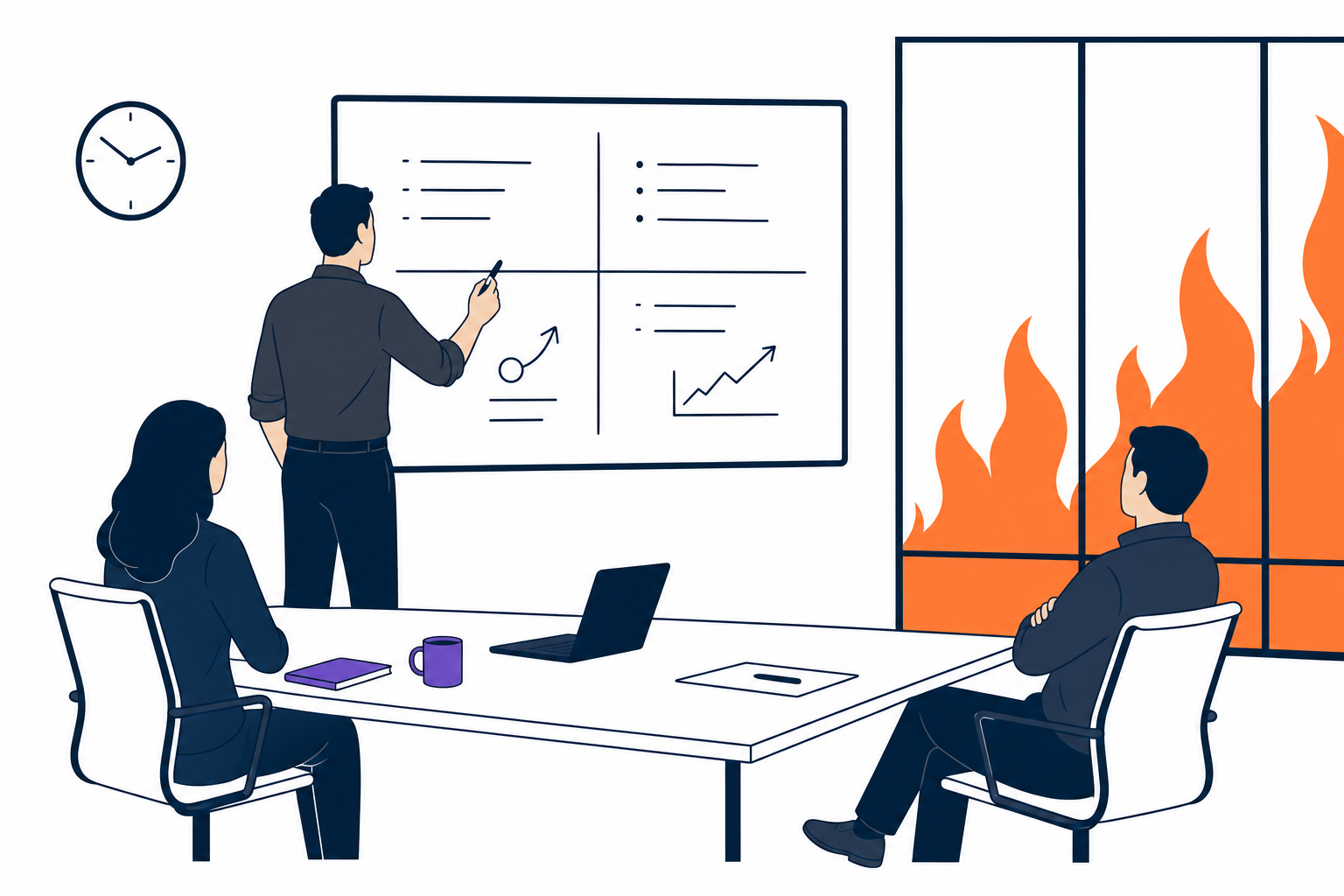
The SWOT framework is sixty years old and most organizations still run it exactly as designed: four quadrants, a conference room, a facilitator with a marker. The problem is not the structure. The problem is that a SWOT is a photograph of a room where everything is on fire, and the exercise ends before anyone asks which wall the fire will reach first. Classic SWOTs name conditions. They do not assign probabilities, time horizons, or directional bets on where each condition is headed. That gap between what is true right now and what will be true in eighteen months is precisely where strategic decisions actually live. A SWOT without foresight is a diagnosis that refuses to call the prognosis.
Strengths Expire, Weaknesses Compound, and the SWOT Treats Both as Static
The foundational error is treating the four quadrants as inventory rather than trajectory. A strength named in January can become table stakes by Q3 if the competitive field catches up. A weakness flagged in last year's offsite can compound silently for two years before it becomes a crisis, and by then the SWOT that identified it is buried in a shared drive. Organizations that run the best strategy reviews understand that every cell in the grid has a velocity: is this strength accelerating, holding, or decaying? Is this threat moving fast or slow? The answer changes the priority order entirely, and no version of the original framework forces you to answer it.
Publicized Initiatives Reveal the Bets Leaders Are Actually Making
You do not need an insider source to read a company's implicit probabilistic view of its own future. Public commitments, hiring patterns, capital allocation announcements, and product sequencing tell you exactly which quadrant leadership is treating as urgent. When a company announces a major operational overhaul in the same quarter it cuts a product line, it is revealing that it scored a specific weakness as high-velocity and a specific opportunity as low-probability. That is a probabilistic SWOT expressed in action, even if no one called it that in the boardroom. The organizations that win are the ones whose public record is coherent: what they said they feared, they acted on; what they said was an opportunity, they funded. The ones that lose are the ones whose SWOT and their resource allocation tell completely different stories.
A SWOT without a time horizon is not a strategy tool. It is an alibi.
Folding in Foresight Does Not Require a Crystal Ball
Probabilistic thinking inside a SWOT is not prediction. It is discipline. For each cell in the grid, the team answers three questions: Is this condition getting stronger or weaker over the next twelve months? What would have to be true for it to flip quadrants? And what is the earliest observable signal that the flip is happening? Those three questions turn a static inventory into a living instrument. Opportunities get ranked not by size but by the probability they remain open. Threats get ranked not by severity but by speed. Strengths get stress-tested against competitive decay curves. The facilitator still needs the marker, but the whiteboard now shows a directional map, not a snapshot.
What This Means for Every Team Running Strategy Reviews
The SWOT is not broken. It is just unfinished. Any team running a strategy review right now can add two columns to every quadrant: a velocity rating and a signal to watch. That alone closes most of the gap between what the framework produces and what leadership actually needs. The bigger implication for the category is this: the organizations that keep running a 1965 SWOT in a competitive environment where conditions move in months, not years, are not doing strategy, they are doing documentation. The framework earned its place in the canon. It has not earned the right to stop evolving. Every planning cycle that treats a SWOT as complete without asking what happens next is a cycle that mistakes the photograph for the film.