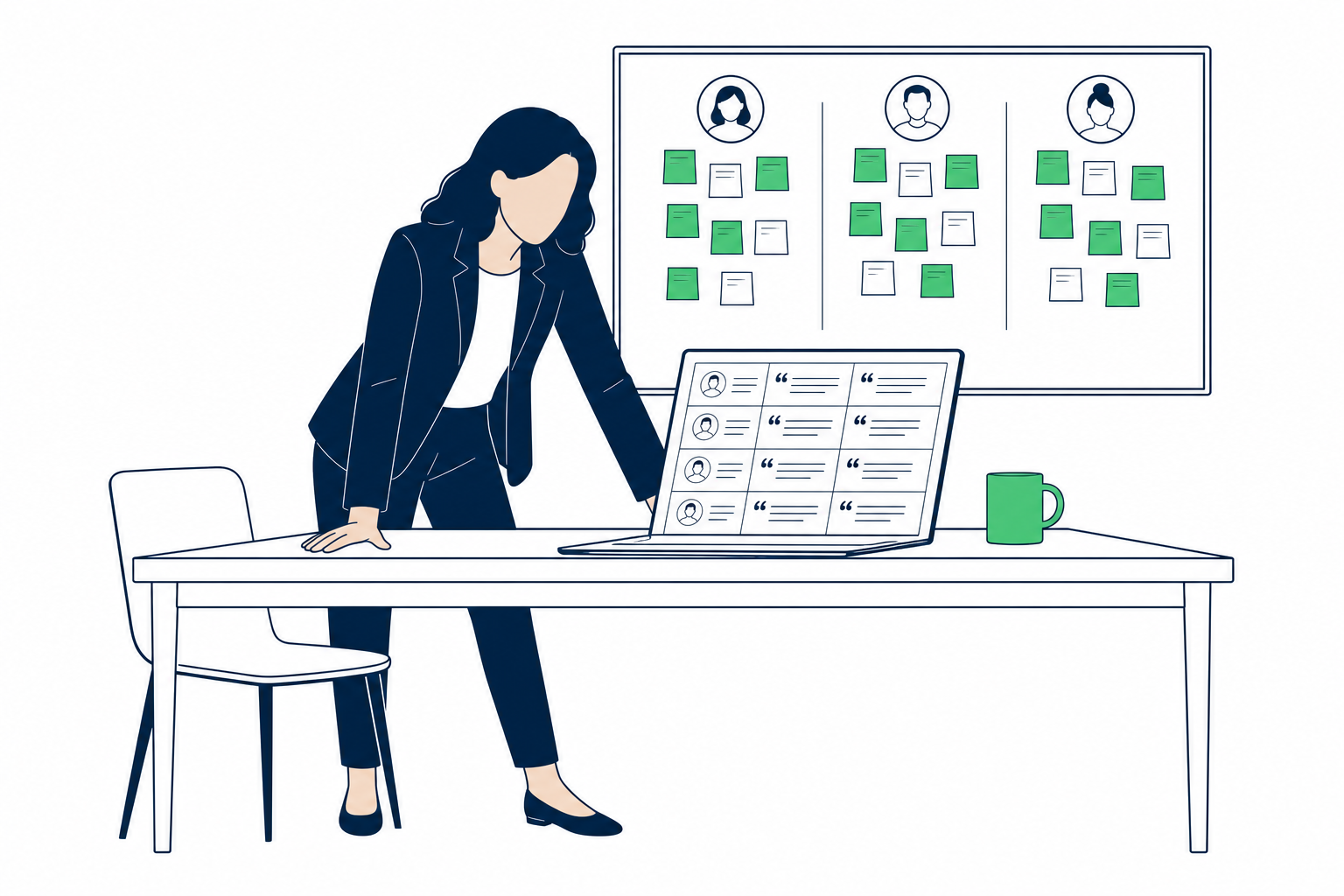
Starbucks built five distinct customer personas out of competitive intelligence, and four of them are angry about the same thing: the queue. The Rushed Commuter ordered ahead to save time and waited longer than the drive-thru. The Loyalty Loyalist redeemed Stars faithfully and still got a drink ten minutes late. The App Reliability Skeptic hit a sign-in failure that blocked the order entirely. The Frontline Barista absorbed all three of their frustrations simultaneously. Only the Deal-Driven Occasional escapes with mixed feelings, showing up for promotions and disengaging the moment the offer expires. That portrait didn't come from a workshop. It came from signals: app reviews, worker accounts, customer voice data, and behavioral patterns mapped across the competitive set. The category's real question isn't what customers want from coffee. It's whether the fulfillment architecture can deliver it.
What Customers Actually Said, and What the Signals Heard
The dominant theme across customer voice is a broken promise of speed. Mobile ordering, which now accounts for roughly 31% of U.S. company-operated Starbucks transactions and surges past 70% during peak urban rushes, was built to save the Rushed Commuter's morning. Instead it created an invisible collision: mobile, delivery, and counter orders all funnel into one shared ticket queue, while drive-thru gets a dedicated lane. Customers report mobile orders running far longer than the counter and drive-thru target window, with no live order-status visibility to explain the gap. One customer had their order vanish entirely after a system outage at 7am, charged with nothing to show for it. That's not a loyalty problem. That's a fulfillment architecture problem wearing a loyalty program's badge.
The app compounds the structural failure rather than masking it. Starbucks' U.S. App Store rank fell from number 13 to number 89, driven by sign-in failures blocking Mobile Order and Pay entirely, Apple Wallet sync failures leaving balances unreadable, and forced gift card reloading that customers read as predatory. Former CEO Howard Schultz named it plainly: the app became the primary vehicle for dissatisfaction. A brand whose loyalty members drive nearly 60% of company-operated U.S. store sales cannot afford a digital front door that closes on arrival.
Dutch Bros Didn't Win on Points. It Won on Layout.
The sharpest finding the competitive signal produces isn't about Starbucks at all. Dutch Bros built dual make-lines and sub-180-second transaction times into its roughly 900-to-1,000-square-foot store format from day one, separating drive-thru production from walk-up and mobile pickup before mobile ordering was a category-level problem. More than half of Dutch Bros mobile customers now choose the walk-up window over the drive lane, a behavior the format was designed to absorb. Dutch Rewards crossed 15 million members without the loyalty infrastructure Starbucks has spent years building, and Gen Z customers self-report higher app engagement at Dutch Bros, describing the app as a gateway to community rather than a points tracker.
Starbucks solved the wrong layer first: the CRM is world-class and the queue is broken.
Why the Personas Workshops Miss and the Signals Don't
A workshop-built persona tells you what customers say they want. A signal-derived persona tells you what they do when the experience fails. Those are different people making different decisions. The Rushed Commuter persona doesn't appear in a focus group because no one describes themselves as someone who tolerates broken promises on a recurring basis. They appear in app review data at 7am, in worker accounts of pressure to make times so the store wouldn't get in trouble, and in the behavioral fact that mobile orders often start production the moment they hit the screen, creating drinks that sit waiting for customers who haven't arrived yet. Starbucks CEO Brian Niccol has publicly acknowledged the company over-indexed on cost efficiency at the expense of experience, a diagnosis that lines up exactly with what the signal stack surfaces. The customer wasn't hiding. The intelligence framework just needed to look in the right place.
What This Means for the Category
The coffee category's competitive currency has shifted from points and tiers to measurable speed, and the brands winning on speed built it into their physical format before the mobile-order wave hit. Starbucks' early fix, a nine-figure labor investment and the Green Apron Service rollout, is showing traction: U.S. transactions grew 4.3% over two consecutive quarters of traffic recovery. But staffing investment and format investment are not the same thing, and Dutch Bros' layout advantage isn't solved by a staffing line item. Any brand operating in this category, or competing for the daily-habit customer alongside it, needs to know which of its own personas are the Rushed Commuter and which are the Deal-Driven Occasional, because those two customers defect for entirely different reasons. Signal-derived personas find that distinction. Workshop personas rarely do. That's the read the full benchmark surfaces across every competitor in the set.