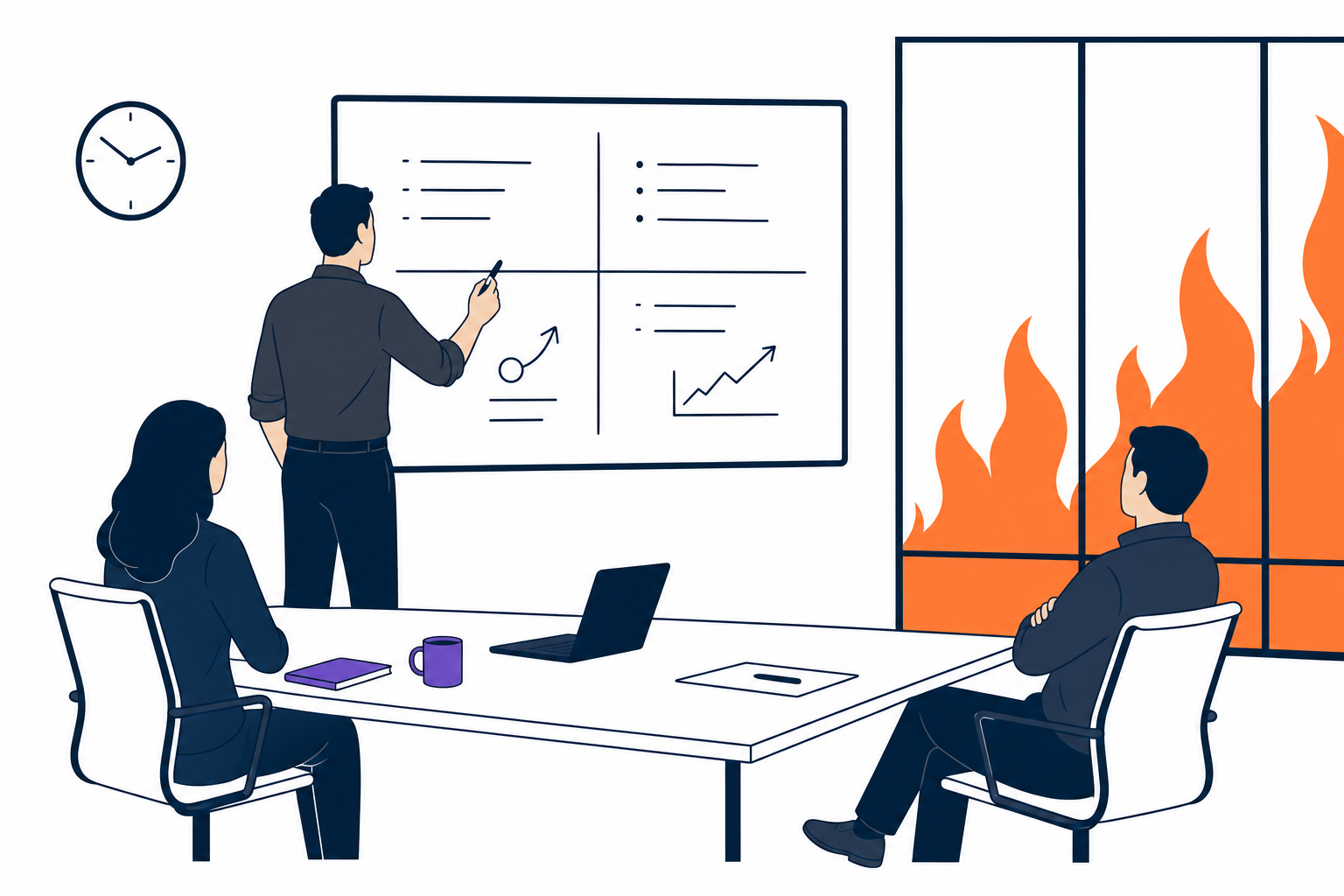
The most common product ideation mistake isn't a lack of creativity. It's watching the wrong industry. Teams benchmark obsessively against direct competitors and arrive at the same ten ideas every quarter, because competitors share the same blind spots, the same customer assumptions, and the same regulatory constraints. The unlock is structural borrowing from adjacent or even unrelated industries: taking the mechanic that solved a problem over there and asking what it does, not what it looks like, before you bring it here. Hotel loyalty programs didn't invent airline miles. Airlines didn't invent the subscription tier. The gym didn't invent the streak. Each mechanic traveled industry lines precisely because someone separated the logic from the context it was born in.
Your Competitors Already Agreed on the Wrong Answer
When every player in a category benchmarks against every other player, the category converges. Features look the same. Onboarding flows mirror each other. Pricing architectures rhyme. This isn't laziness; it's rational behavior under competitive pressure. The problem is that convergence optimizes for parity, not breakthrough. The ceiling of a benchmarking-against-peers strategy is a slightly better version of what already exists. Adjacent-industry borrowing breaks the convergence trap because the source material carries none of your category's inherited assumptions.
The Mechanic Travels. The Context Doesn't.
Here's where most teams get it wrong: they see a mechanic working somewhere else and import the whole package, context included. A B2B SaaS team sees consumer gaming's streak mechanic and builds a leaderboard inside an enterprise workflow tool, then wonders why adoption craters. The mechanic was real. The context transfer killed it. Enterprise users aren't competing against colleagues for status; they're trying to close a quarter. The right move is to ask what the streak mechanic actually does structurally: it creates a cost of inaction that compounds over time. Then ask where that structural job needs doing in your product. The answer is almost never a leaderboard.
The mechanic is the part that travels. The context is the part you have to leave behind.
The Analogy Test That Actually Works
A reliable discipline for this: pick an industry solving a structurally similar problem, not a superficially similar one. Structurally similar means the same customer tension is in play, even if the product category is completely foreign. Healthcare appointment scheduling and restaurant reservations share almost no surface features, but they share the same structural problem: a customer who commits in advance and then faces a friction-filled gap before value is delivered. No-show reduction mechanics, pre-visit engagement flows, and reminder sequencing have traveled between those two industries successfully because the underlying tension is identical. Surface similarity is a distraction. Structural similarity is the signal.
What This Means for Any Product Category
The teams that compound innovation over time aren't more creative. They have a wider scanning radius. They've built a habit of asking: who else has this problem, regardless of industry, and what did they build? That question, asked rigorously and regularly, surfaces mechanics that competitors haven't seen because competitors aren't looking there. The practical implication is a shift in research posture: spend less time on competitor teardowns, more time on structural problem mapping across industries. Every category has three or four solved-elsewhere problems sitting inside it, waiting to be imported correctly. The work isn't finding them. The work is stripping the context before you bring them home.